
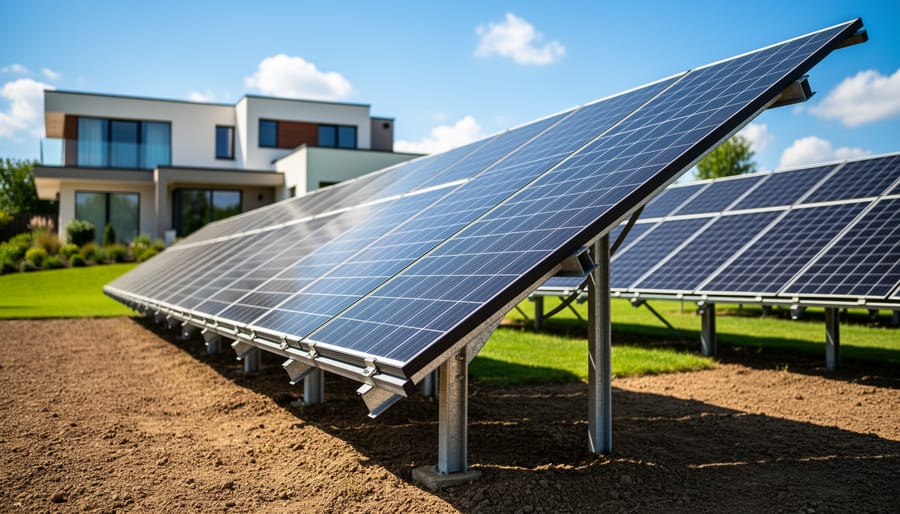
Ground mount solar systems are photovoltaic arrays installed on the ground rather than on rooftops, offering property owners with adequate land space greater flexibility in panel placement, easier maintenance access, and often superior energy production compared to roof-based installations. If you’re evaluating solar options and have an unused yard, field, or cleared land, ground-mounted systems deliver a practical solution that sidesteps the limitations of roof condition, orientation, and structural capacity.
The appeal is straightforward. Ground mount systems allow you to position panels at the optimal angle and direction for maximum sun exposure, regardless of how your home or building faces. You’re not constrained by shading from chimneys or nearby trees, and you won’t need to worry about roof penetrations, load-bearing calculations, or whether your shingles will last another 25 years. Maintenance becomes simpler too. Cleaning panels, checking connections, and inspecting hardware requires no ladder work or safety harnesses.
For many property owners, the decision hinges on land availability and budget. Ground systems typically cost 10 to 15 percent more than rooftop installations due to additional mounting hardware, trenching for electrical conduit, and site preparation. But that premium often pays off through higher energy yields and decades of trouble-free operation. A commercial vineyard in Northern California, for example, installed a 50-kilowatt ground array in 2024 that now generates enough power to offset irrigation pumps and refrigeration costs year-round, with panels positioned to avoid shading during winter months when roof-mounted alternatives would have underperformed.
Whether ground mount solar systems make sense for your property depends on space, terrain, local zoning rules, and your long-term energy goals. This guide breaks down the essentials to help you make an informed choice.
What Makes Ground Mount Solar Systems Different
Ground mount solar systems anchor panels directly to the earth using specialized mounting structures, rather than attaching them to a building’s roof. This fundamental difference transforms how solar arrays are designed, installed, and maintained throughout their 25-30 year lifespan.
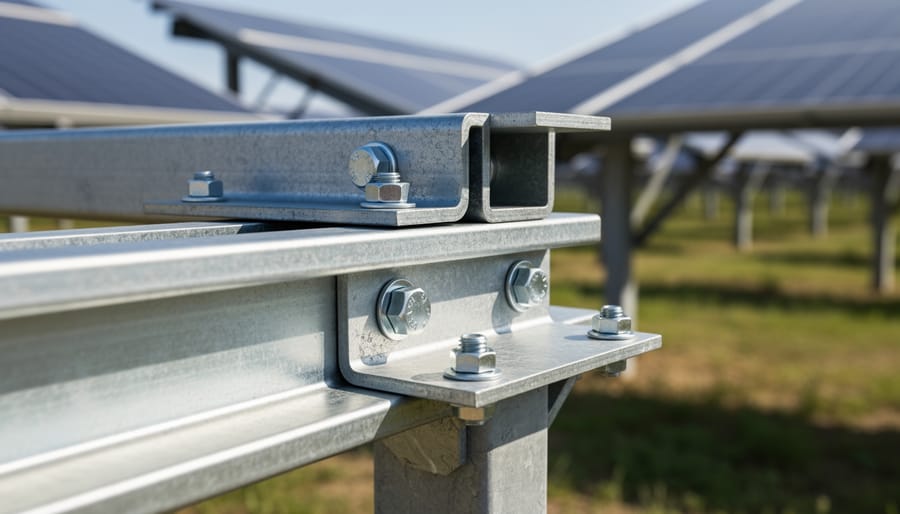
The foundation of every ground-mounted array starts below the surface. Installers either drive steel posts deep into the ground, pour concrete footings, or use helical piles that screw into the soil like massive anchors. The choice depends on your soil composition, frost depth, and local wind loads. Once secure, these foundations support the racking system that holds your panels at the optimal angle.
- Ballasted Mounts
- Ground-mounted systems that use weighted bases instead of penetrating the soil, ideal for areas with rocky terrain or shallow bedrock. These allow for installation without excavation while maintaining structural stability.
- Pole Mounts
- Single-pole or dual-pole structures that elevate panels higher off the ground, often with tracking capability to follow the sun’s path. They require less ground space and simplify maintenance access.
- Foundation Types
- The underground support system ranging from concrete piers to driven posts to helical screw piles, selected based on soil conditions, frost lines, and engineering requirements. Proper foundation design prevents shifting and ensures decades of stable performance.
- Racking Systems
- The metal framework that connects foundations to solar panels, holding arrays at fixed angles or enabling tracking movement. These aluminum or galvanized steel structures resist corrosion and accommodate thermal expansion.
The most common configuration uses fixed-tilt racking, where panels sit at a predetermined angle facing south. This simple setup works for most properties and requires minimal maintenance. For those seeking maximum production, single-axis tracking systems rotate panels east to west throughout the day, capturing up to 25% more sunlight than fixed arrays.
Unlike rooftop installations constrained by existing angles and orientations, ground systems give you complete control over panel placement. You can position arrays away from shade, space them to prevent row shading, and expand your system across multiple ground areas if needed. This flexibility extends to maintenance too. Technicians walk between rows to clean panels, inspect connections, and replace components without navigating a pitched roof or risking damage to shingles.
The Clear Advantages of Ground-Mounted Solar Arrays
Maximum Energy Production Through Perfect Positioning
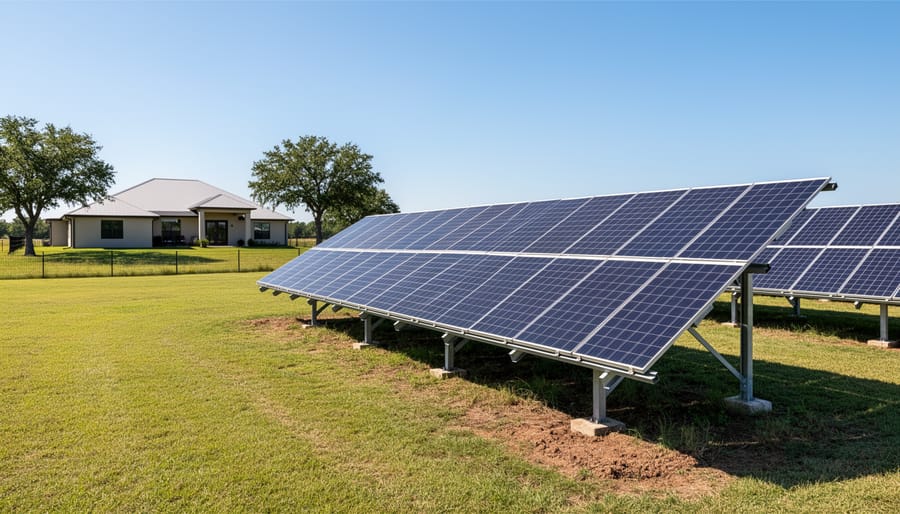
Ground-mounted arrays achieve significantly higher energy production by eliminating the positioning constraints that rooftops impose. Unlike roof installations locked into a home’s existing pitch and orientation, ground systems can be angled at the mathematically optimal tilt for your latitude, typically between 30 and 40 degrees in most U.S. regions, and pointed directly south (or north in the Southern Hemisphere) to capture maximum sunlight throughout the day.
This precision matters more than many property owners realize. A roof sloping east-west or facing northwest might capture only 70-80% of potential solar energy, while a properly positioned ground array harvests nearly 100% of available sunlight. The difference translates to 10-25% higher annual energy production from the same number of panels, meaning faster payback periods and greater long-term savings.
Seasonal adjustments further boost performance. Many ground mount solar systems accommodate manual or automated tilt changes, allowing panels to sit flatter in summer when the sun rides high and steeper in winter when it arcs lower across the sky. This seasonal optimization can add another 5-10% to yearly output, an improvement impossible with fixed rooftop installations.
The consistent airflow beneath elevated ground arrays also keeps panels cooler, maintaining higher efficiency. Solar cells lose roughly 0.5% efficiency for every degree Celsius above their rated temperature, so the natural cooling of ground-mounted systems preserves peak performance even during hot summer months when energy demand spikes.
Long-Term Cost Savings That Add Up
Ground mount solar systems deliver substantial cost advantages that extend far beyond the initial installation. The most immediate savings come from maintenance accessibility, technicians can service panels at ground level without scaffolding, boom lifts, or specialized rooftop safety equipment, cutting maintenance calls by 30-40% compared to rooftop arrays.
Cleaning efficiency translates directly to your bottom line. Dust, pollen, and debris reduce panel output by 5-15% annually, and ground systems let you hose down panels yourself in minutes rather than hiring professionals for rooftop cleaning at $150-300 per session. Property owners who clean quarterly report maintaining 94-97% of rated capacity versus 82-88% for neglected rooftop installations.
Repair work becomes straightforward when everything sits at eye level. A cracked panel or faulty inverter connection that might cost $800-1,200 to fix on a roof runs $200-400 for ground systems because technicians spend time fixing problems, not navigating safety protocols. Over a system’s 25-year lifespan, this accessibility saves $3,000-6,000 in service calls.
Perhaps the biggest hidden benefit: you avoid roof penetration entirely. Every mounting bracket drilled through shingles creates a potential leak point. Roof repairs around solar hardware average $2,500-5,000, and removing panels for roof replacement adds another $1,500-3,000. Ground mount solar systems eliminate these risks completely, protecting your roof’s integrity and your wallet simultaneously.
Environmental Impact Beyond Carbon Reduction
Ground-mounted solar panels deliver environmental benefits that extend far beyond emission reductions. By keeping panels off your roof, you eliminate the need for penetrations that can compromise roof integrity and lead to leaks over time. The installation avoids disturbing existing roofing materials, preserving their warranty and extending their lifespan.
Ground systems also open the door to dual-use agrivoltaics where the land beneath and around panels continues serving agricultural purposes. Farmers graze sheep, grow shade-tolerant crops, or maintain pollinator habitats under elevated arrays, making productive use of the same footprint that generates clean energy.
Better air circulation around ground-mounted panels keeps them cooler than roof-mounted equivalents, which boosts efficiency and reduces thermal stress on components. Cooler panels degrade more slowly, extending system lifespan by years and reducing the need for premature replacements. This combination of land preservation, agricultural integration, and enhanced durability makes ground mount solar systems a genuinely sustainable choice for properties with available space.
Is Your Property Right for Ground Mount Solar?
Ground mount solar systems work exceptionally well for many properties, but they’re not a universal fit. Three primary factors determine whether your site is suitable: available space, ground conditions, and local regulations.
Space Requirements
You’ll need a minimum of 200-300 square feet of unshaded land for a typical residential system, though larger installations naturally require more. Each kilowatt of solar capacity demands roughly 80-100 square feet when accounting for optimal spacing between rows. Walk your property during midday in winter, the sun’s lowest season, to identify areas that remain sunny year-round. Trees, buildings, or terrain features that cast shadows will reduce your usable space.
| Property Type | Ideal System Size | Space Required | Typical ROI Timeline |
|---|---|---|---|
| Residential (1+ acre) | 8-12 kW | 800-1,200 sq ft | 6-8 years |
| Small residential lots | 4-6 kW | 400-600 sq ft | 7-10 years |
| Commercial facilities | 50-200 kW | 5,000-20,000 sq ft | 5-7 years |
| Agricultural operations | 25-100 kW | 2,500-10,000 sq ft | 6-9 years |
The land doesn’t need to be pristine lawn. Many properties successfully integrate arrays into areas with native grasses, clover, or low ground cover that allows for dual land use.
Soil and Ground Conditions
Your installer will assess soil composition to determine the appropriate foundation type. Clay, sandy loam, or mixed soils generally work well with driven-pile or helical-screw foundations. Rocky terrain may require concrete ballast systems or drilled piers, which add to installation costs. Extreme slopes above 15 degrees typically need terracing or specialized racking, though moderate grades often improve drainage without complicating installation.
Zoning and Regulatory Considerations
Check your local zoning code for setback requirements, most jurisdictions mandate 5-15 feet from property lines. Some municipalities classify ground arrays as structures requiring building permits, while others treat them as accessory equipment with simpler approval processes. Homeowners associations may have aesthetic guidelines or restrictions on visible installations. Agricultural properties often face fewer restrictions and may qualify for additional tax incentives.
Budget Realities
Ground mount systems cost $3,000-$5,000 more than comparable rooftop installations due to foundation work and trenching for electrical runs. However, this premium often pays back through higher energy production and lower long-term maintenance expenses. If your roof needs replacement within ten years, ground mounting avoids the disruption and cost of temporarily removing and reinstalling panels.
Properties with ample sunny land, stable ground conditions, supportive local codes, and owners planning to stay 7-10 years represent the ideal scenario for ground mount solar.
Installation Considerations and What to Expect
Installing a ground-mounted solar array involves several distinct phases, and understanding what happens at each stage helps you prepare and set realistic expectations.
The timeline typically spans 4-8 weeks from contract signing to system activation, though permitting and utility interconnection approvals can extend this window. Your installer will coordinate the entire process, but knowing the sequence helps you plan accordingly.
Site Assessment and Engineering
Professional installers begin with a detailed site survey, evaluating soil composition, sun exposure patterns, and drainage characteristics. They’ll test soil bearing capacity to determine the appropriate foundation type, concrete footings work well in stable soil, while helical piers suit sandy or unstable ground. Engineers design the mounting structure to withstand local wind loads and snow accumulation, ensuring your system remains secure through severe weather.
Permitting and Approvals
Most jurisdictions require building permits for ground mount installations. Your installer handles permit applications, submitting engineered drawings and electrical plans to local building departments. This phase also includes utility interconnection agreements, which authorize your system to feed excess power back to the grid. Some properties need zoning variance approvals, particularly if setback requirements or height restrictions apply. Count on 2-4 weeks for permit processing in most areas.
Site Preparation
Crews clear vegetation and level the installation area, typically removing 6-12 inches of topsoil to reach stable subsoil. They mark foundation locations precisely, accounting for panel spacing that allows maintenance access and prevents shading. Proper grading ensures water drains away from the array, protecting foundations from erosion and frost heave.
Foundation and Mounting
Installers pour concrete footings or drive helical piers, depending on your soil conditions and system size. Footings cure for several days before crews bolt on the racking structure. Ground screws offer faster installation in suitable soil types, eliminating concrete work entirely. The mounting rails attach to these foundations, creating the framework that holds your panels at the optimal angle.
Electrical Work and Activation
Electricians run conduit from the array to your main electrical panel, installing inverters and disconnect switches. They wire panels in strings, test all connections, and verify proper grounding. Final inspections by local authorities and utility representatives clear the way for system activation, usually completing within 1-2 days after installation wraps up.
Ground Mount vs. Rooftop: Making the Right Choice
Choosing between ground mount and rooftop solar isn’t about which technology is universally better, it’s about matching the system to your property’s characteristics and your priorities.
Upfront Investment and Long-Term Value
Ground mount systems typically cost 10-15% more than rooftop installations due to additional materials for racking, concrete foundations, and trenching for electrical runs. A typical residential ground mount runs $18,000-$25,000 after incentives, compared to $15,000-$21,000 for comparable rooftop systems. However, this initial premium often pays for itself through higher energy production and lower maintenance costs over the system’s 25-30 year lifespan.
Rooftop installations make financial sense when you have suitable roof conditions, good solar exposure, structurally sound surfaces, and a roof age that won’t require replacement within 10-15 years. Removing and reinstalling panels during roof work adds $3,000-$5,000 to future expenses.
Space Requirements and Property Impact
Ground systems need available land, typically 100-150 square feet per kilowatt of capacity. A standard 8kW residential system occupies roughly 1,200 square feet, about the size of a two-car garage footprint. This space must receive full sun and remain accessible for maintenance.
Properties with limited yard space, heavily shaded lots, or extensive landscaping often find rooftop installations more practical. Urban and suburban homes with premium outdoor living areas may prefer preserving yard space for other uses.
- Optimal panel angle and orientation regardless of roof pitch delivers 10-25% more energy production.
- Accessible placement simplifies cleaning, repairs, and system expansion without climbing ladders or navigating rooflines.
- Zero roof penetrations eliminate leak risks and preserve roof warranty coverage.
- Superior air circulation beneath panels improves efficiency through better heat dissipation.
- Higher upfront costs for foundation work, mounting structures, and electrical trenching add 10-15% to initial investment.
- Requires dedicated yard space that could otherwise serve recreational, aesthetic, or agricultural purposes.
- More visible from ground level, which some neighborhoods or homeowners associations may restrict or find less appealing.
- Potential vulnerability to lawn equipment damage, though proper fencing typically prevents this issue.
Aesthetic and Practical Considerations
Visual impact matters differently to each property owner. Ground arrays remain visible at eye level but can be screened with landscaping or positioned in less prominent areas. Rooftop systems blend with the roofline from ground view but stand out prominently from elevated vantage points and aerial photography.
Homeowners associations and local zoning codes sometimes restrict ground mount visibility from streets or neighboring properties. Check these requirements before deciding, as setback rules and screening mandates vary widely by jurisdiction.
The right choice depends on your specific situation. Ground mount solar systems excel when you have available land, want maximum production, or face roof limitations like age, shading, or unsuitable orientation. Rooftop installations work best when yard space is limited, your roof offers good solar access, and you prefer lower upfront costs.
Real Success Stories: Properties Thriving with Ground Mount Solar
Nothing proves the value of ground-mount solar quite like seeing it in action. These two installations demonstrate how property owners transformed underused land into reliable energy sources while cutting costs and carbon emissions.
Residential Installation: 15kW Array in Rural Pennsylvania
When the Morrison family assessed their 3-acre property in 2025, their aging roof made rooftop solar impractical. Instead, they installed a 15kW ground-mounted array on a quarter-acre section of their backyard that had previously served only as mowing space.
The results exceeded expectations. Their optimally-angled panels generated 22% more electricity than comparable rooftop systems in their region would have produced. Monthly utility bills dropped from an average of $245 to just $31, saving the family approximately $2,570 annually. Within the first year, they offset 18 tons of carbon dioxide, equivalent to planting 420 trees.
“The best part is how accessible everything is,” Mrs. Morrison notes. “When leaves accumulate in fall, I can clear the panels myself in 20 minutes. No ladders, no safety concerns, and the system keeps producing at peak efficiency.”
Commercial Installation: 75kW System at Manufacturing Facility
A metal fabrication company in Ohio faced a different challenge: their 40,000-square-foot facility had a roof structure unable to support significant solar weight. In early 2025, they converted an unused gravel lot into a ground-mounted solar farm with 75kW capacity.
The installation delivered immediate financial impact. Their first-year energy costs decreased by $14,800, with the system generating 94 megawatt-hours of clean electricity. The company’s return on investment timeline shortened to 6.2 years thanks to federal tax credits and accelerated depreciation benefits.
Operations manager David Chen emphasizes the maintenance advantage: “Our team can inspect and clean panels during lunch breaks without disrupting production or hiring specialists. That accessibility translates directly to consistent performance and lower operating costs.”
Both properties now serve as local examples of how ground-mount solar systems turn available land into productive energy assets.
Common Questions About Ground Mount Solar Systems
How much do ground mount solar systems typically cost compared to rooftop installations?
Ground-mounted systems generally cost $3,000 to $5,000 more than comparable rooftop installations due to additional foundation work and racking materials. However, this upfront difference is often offset within 2-3 years through higher energy production and lower maintenance expenses over the system’s lifetime.
What maintenance do ground-mounted arrays require?
These systems need minimal upkeep, typically just panel cleaning two to four times per year and an annual inspection of mounting hardware and electrical connections. The ground-level access makes maintenance significantly easier and safer than rooftop systems, with no need for ladders or specialized equipment.
Will snow damage my ground mount solar panels?
Snow rarely causes damage because ground systems are designed with adequate tilt angles that allow snow to slide off naturally. In heavy snow regions, you can also clear panels manually from ground level without safety risks, and most systems resume full production within hours of snowfall ending.
What warranty coverage comes with ground-mounted solar installations?
Quality ground mount systems include 25-year panel warranties, 10-25 year inverter warranties, and 10-20 year warranties on mounting structures and hardware. Professional installers typically provide separate workmanship warranties covering labor and installation for 5-10 years.
Can I add battery storage to an existing ground mount system?
Yes, ground-mounted arrays are fully compatible with battery storage systems and actually make integration simpler since the equipment can be installed near the array rather than inside your home. Most modern inverters support battery addition either during initial installation or as a future upgrade.
Do ground mount solar systems work in areas with high winds?
Properly engineered ground systems withstand winds up to 140 mph when designed according to local building codes. The foundation design, whether driven posts, concrete ballast, or helical anchors, is specifically calculated for your region’s wind loads and soil conditions to ensure long-term stability.
Beyond these common concerns, property owners often wonder about the permitting timeline and whether their homeowners association allows ground-mounted installations. Most jurisdictions process ground mount permits within 4-8 weeks, similar to rooftop systems, though some rural areas move faster while suburban locations may require additional zoning approvals. If you live in a community with an HOA, review the covenants before planning your system, as some associations restrict visible installations while others have clear guidelines about setbacks and screening requirements.
The land beneath your panels can still serve multiple purposes. Many property owners maintain native grasses or wildflowers in the array footprint, which supports pollinators and reduces erosion. Others use the shaded area for small livestock grazing or as covered storage for equipment. This dual-use approach maximizes your property’s functionality rather than dedicating space exclusively to energy production.
Ground mount solar systems represent a smart investment that pays dividends for decades. While the upfront cost may seem substantial, property owners consistently save thousands of dollars over their system’s 25-30 year lifespan through reduced utility bills and minimal maintenance expenses. The environmental impact extends beyond your carbon footprint, these installations protect your roof’s integrity, allow for creative land use, and often produce 10-25% more energy than comparable rooftop arrays.
The decision to go ground-mounted isn’t right for every property, but if you have available land and value long-term performance over short-term convenience, it’s worth serious consideration. The flexibility to position panels at optimal angles, the ease of maintenance access, and the ability to expand your system as needs grow make ground mount installations particularly attractive for those planning to stay in their homes or businesses for years to come.
Don’t navigate this decision alone. A certified solar professional can assess your property’s specific conditions, from soil composition to sun exposure, and provide accurate projections of energy production and savings. They’ll help you understand local permitting requirements, available incentives, and whether a ground mount system truly makes financial and practical sense for your situation. Schedule a professional site assessment to discover your property’s solar potential and take the first step toward energy independence.