
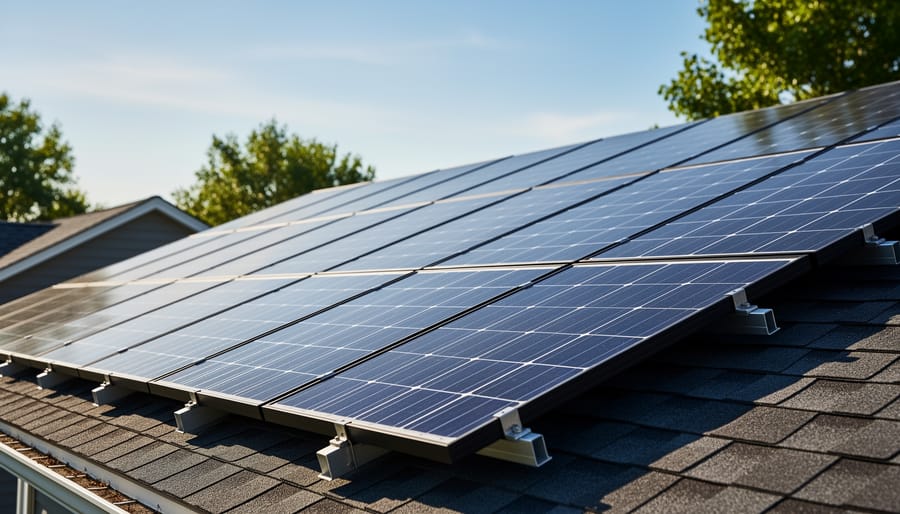
Solar energy converts sunlight into electricity through photovoltaic cells that absorb photons and release electrons, creating a direct current that an inverter transforms into usable alternating current for your home or business. This process happens silently and continuously whenever light hits your panels, with no moving parts to wear out and no fuel required beyond the sun itself.
Understanding how solar panels work matters because it demystifies the technology behind one of the fastest-growing energy solutions of 2026. The science is surprisingly straightforward: each solar cell contains layers of silicon treated to create positive and negative charges. When sunlight strikes these layers, it knocks electrons loose, and the design of the cell forces them to flow in one direction, generating electricity. What makes this remarkable is the simplicity and reliability of the process. Once installed, solar panels require minimal maintenance while producing clean energy for 25 years or longer.
The efficiency of this conversion depends on several factors, from panel orientation and local climate to the quality of components and proper system sizing. Modern solar installations also include storage options that capture excess energy for use after sunset, addressing one of the most common questions homeowners have about going solar. Real-world results speak to the technology’s maturity: residential systems regularly offset 70-100% of electricity bills while reducing carbon footprints by several tons annually. By grasping the fundamentals of the solar energy process, you can make informed decisions about whether this proven technology fits your property and long-term financial goals.
The Science Behind Solar Energy: Photovoltaic Effect Explained
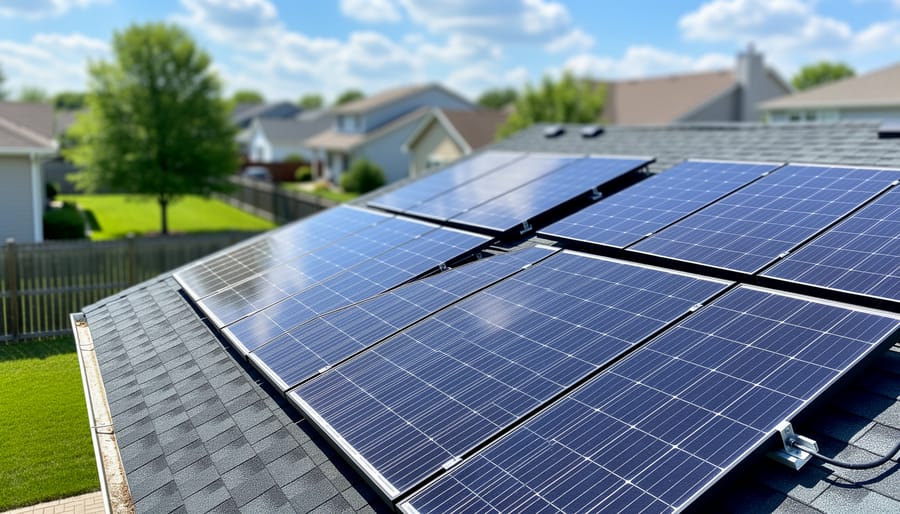
At the heart of every solar panel lies a remarkable physical phenomenon called the photovoltaic effect. Discovered in 1839 by French physicist Edmond Becquerel, this process transforms light directly into electricity without any moving parts, fuel, or emissions. Understanding how it works demystifies solar technology and reveals why these systems can reliably generate power for decades.
The photovoltaic effect occurs when light particles, called photons, strike certain materials and knock electrons loose from their atoms. Think of it like a game of pool where the photons are the cue ball striking other balls into motion. When these freed electrons begin to flow in a specific direction, they create an electric current we can harness.
Solar cells are engineered specifically to make this electron movement happen efficiently. They’re made from semiconductor materials, most commonly silicon, which sits right in the middle between materials that conduct electricity easily and those that don’t conduct it at all. This middle-ground property makes silicon perfect for controlling electron flow.
What makes a solar cell work is how it’s constructed. Manufacturers create two layers of silicon with different electrical properties. The top layer has extra electrons, while the bottom layer has spaces where electrons are missing. When these layers meet, they create an electric field at the junction, similar to the way a magnet’s north and south poles create a magnetic field.
Here’s where the magic happens. When sunlight strikes the solar cell, photons energize electrons in the silicon. The electric field at the junction pushes these newly energized electrons toward metal contacts on the cell’s surface. Once they reach these contacts, they flow through an external circuit as electricity, powering your lights, appliances, and devices before returning to the cell to start the journey again.
This continuous cycle happens billions of times per second across thousands of solar cells in your panel array. Each photon that successfully frees an electron contributes to the steady flow of electricity from your roof to your home. The process is silent, clean, and remarkably consistent, which is why solar panels can maintain 80-90% of their original efficiency even after 25 years of operation.
Step-by-Step: What Happens When Sunlight Hits Your Solar Panels
Photon Absorption in Solar Cells
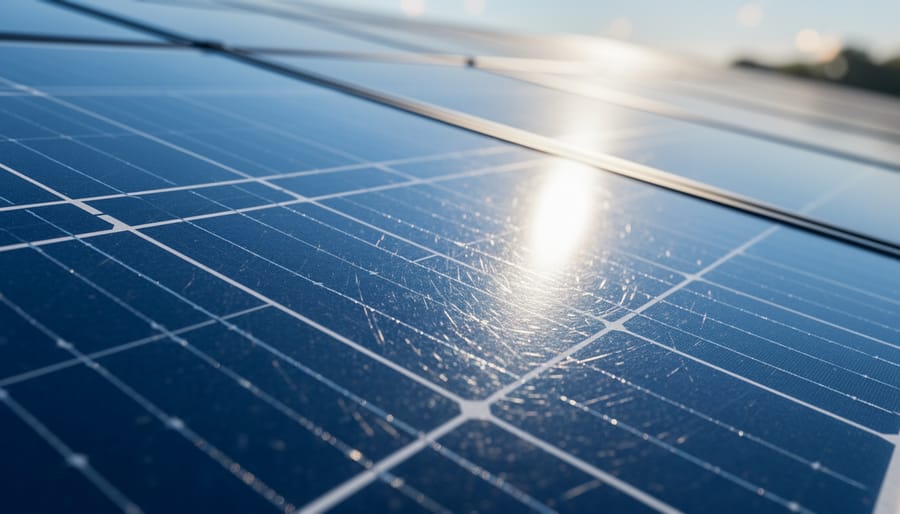
When sunlight reaches your solar panel, individual particles of light called photons strike the silicon cells that make up the panel’s surface. Each photon carries a specific amount of energy that corresponds to the wavelength of light. Silicon, the semiconductor material used in most solar cells, has a crystalline structure with electrons loosely bound to its atoms. When a photon with sufficient energy hits this silicon, it transfers its energy to an electron, knocking it free from its atomic bond. This process happens billions of times per second across the panel’s surface.
The freed electrons create what’s called an “electron-hole pair”, the liberated electron leaves behind a positively charged gap. The panel’s built-in electric field, created by layering different types of silicon, then pushes these electrons in a specific direction, generating electrical current. The efficiency of this absorption process depends on factors including the silicon’s purity, the panel’s design, and how cells are connected in your system’s series vs parallel configuration.
From DC to AC: The Inverter’s Critical Role
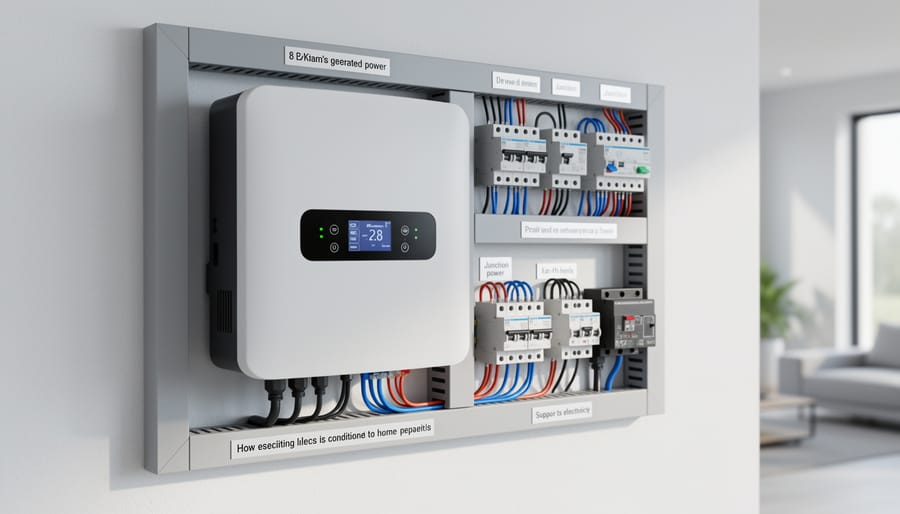
Your solar panels generate direct current (DC) electricity, but your home runs on alternating current (AC). That’s where the inverter becomes essential. This device transforms the DC power flowing from your panels into the AC electricity that powers everything from your refrigerator to your laptop.
The conversion process happens rapidly and continuously throughout the day. As your solar inverter converts DC to AC it also ensures the electricity matches your home’s voltage and frequency requirements, typically 120/240 volts at 60 Hz in North America. Modern inverters achieve efficiency rates above 96%, meaning very little energy is lost during this transformation.
There are three main inverter types to consider. String inverters handle all your panels as one unit and represent the most cost-effective option. Microinverters attach to individual panels, optimizing performance when shading affects parts of your array. Power optimizers offer a middle ground, pairing panel-level conditioning with a central inverter.
Your inverter also acts as a safety device, immediately shutting down if the grid loses power. This protects utility workers during outages. Many inverters include monitoring capabilities too, letting you track your system’s real-time production and spot any issues quickly.
Energy Flow to Your Electrical Panel
Once the inverter converts DC power to AC electricity, the energy flows seamlessly into your home or business through your main electrical panel, the same distribution box that manages power from the grid. This is where solar integration becomes invisible to your daily operations.
The electrical panel acts as a traffic controller, directing power where it’s needed in real time. When your solar system generates electricity, it first satisfies your immediate energy demand. If you’re running appliances, lights, or equipment, they draw power directly from your solar panels rather than the utility grid. This happens automatically, with no switches to flip or systems to monitor.
Your utility meter plays a crucial role here. During peak production hours, your solar system often generates more electricity than you’re using. The excess power flows backward through the meter to the grid, typically earning you credits through net metering programs. At night or during cloudy periods, you draw from the grid as usual, but those accumulated credits offset your consumption.
This bidirectional flow means your existing electrical infrastructure requires minimal modification. Most installations only need a compatible meter and proper interconnection equipment. The result is a hybrid system that maximizes your solar investment while maintaining reliable power regardless of weather or time of day.
Key Components That Make Solar Energy Conversion Possible
Solar Panels: Types and Efficiency Differences
The type of solar panel you choose directly impacts how efficiently sunlight converts into usable electricity. Three main panel technologies dominate today’s market, each with distinct characteristics that affect the solar energy process.
Monocrystalline panels achieve the highest efficiency rates, typically converting 20-22% of sunlight into electricity. These panels use silicon crystals grown from a single, continuous crystal structure, which allows electrons to flow more freely during the photovoltaic process. Their dark, uniform appearance and superior performance in limited space make them ideal for residential rooftops where maximizing output per square foot matters. They also maintain better performance in high temperatures compared to other types.
Polycrystalline panels offer a more budget-friendly option, with efficiency rates around 15-17%. Manufacturers create these panels by melting multiple silicon fragments together, resulting in a blue, speckled appearance. While they require slightly more roof space to generate the same power output as monocrystalline panels, their lower cost makes them attractive for larger installations where space isn’t constrained.
Thin-film panels represent the most flexible technology, literally and figuratively. These lightweight panels achieve 10-12% efficiency but excel in specific applications. They perform better in partial shade and high heat, making them suitable for commercial buildings with challenging roof conditions. Their lower efficiency means they need substantially more installation area to match crystalline panel output.
Your specific situation, available roof space, budget, shading conditions, and aesthetic preferences, determines which technology optimizes your solar energy conversion process.
Balance of System Components
While solar panels and inverters get most of the attention, your system’s reliability depends on several critical supporting components working behind the scenes.
The mounting system secures panels at the optimal angle and orientation, built to withstand decades of wind, rain, and temperature extremes. Proper racking ensures panels stay positioned for maximum sunlight exposure while protecting your roof structure. Quality mounts prevent long-term issues like leaks or panel misalignment that reduce energy production.
Electrical wiring connects individual panels and routes electricity safely to your inverter and electrical panel. The panel wiring layout directly impacts your system’s voltage, current flow, and overall performance. Professional-grade wiring handles the electrical load while meeting strict safety codes.
Disconnect switches provide emergency shut-off capability, allowing you to isolate the solar system from your home’s electrical panel for maintenance or safety. Most jurisdictions require both AC and DC disconnects as mandatory safety features.
Monitoring equipment tracks real-time energy production and system health, alerting you to performance issues before they become costly problems. These components work together seamlessly, creating a safe, efficient pathway for solar electricity to power your property for 25 years or more.
What Affects Solar Energy Production Throughout the Day
Solar panels don’t produce electricity at a constant rate throughout the day. Multiple factors influence how efficiently your system converts sunlight into usable power, and understanding these variables helps you set realistic expectations for your investment.
Time of Day and Sun Angle
Your solar panels generate peak electricity during midday hours when the sun sits highest in the sky. As the sun moves lower toward the horizon in early morning and late afternoon, sunlight travels through more atmosphere and strikes your panels at less optimal angles. This reduces energy production by 40-60% compared to peak hours. The steeper the sun’s angle relative to your panels, the more photons your solar cells can capture and convert.
Weather and Cloud Cover
Clear, sunny days deliver maximum solar production, but your system still generates electricity on cloudy days, just at reduced capacity. Light clouds might decrease output by 10-25%, while heavy overcast conditions can cut production by 60-80%. Rain actually benefits your system by cleaning dust and debris from panel surfaces, which can improve efficiency once skies clear. Temperature also plays a role: extremely hot days (above 77°F) slightly reduce panel efficiency, while cooler temperatures with bright sunshine create ideal conditions.
Seasonal Variations
Winter months bring shorter days and lower sun angles, typically reducing energy production by 40-50% compared to summer peaks. However, this doesn’t mean your system underperforms financially. Most solar calculations account for seasonal fluctuations, and your annual production still delivers substantial savings. In many regions, crisp winter days with reflective snow can produce surprisingly strong output despite fewer daylight hours.
System Orientation and Shading
South-facing panels in the Northern Hemisphere capture the most sunlight throughout the day, while east or west orientations reduce annual production by roughly 15-20%. Even partial shading from trees, chimneys, or neighboring structures can dramatically impact output. Modern systems with microinverters or power optimizers minimize shading losses by preventing one shaded panel from dragging down the entire array’s performance. Proper system placement, which highlights ground mount benefits for properties with shading issues, ensures you maximize energy conversion across all conditions.
Professional installers account for all these factors when sizing your system, ensuring your solar investment meets your energy needs year-round despite daily and seasonal production fluctuations.
Energy Storage: What Happens When the Sun Goes Down
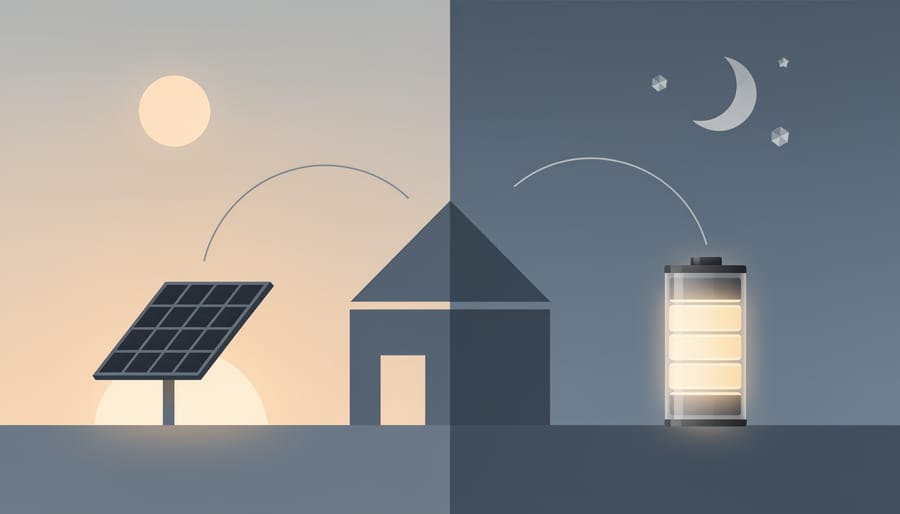
When the sun sets or clouds roll in, your solar panels stop generating electricity, but your home or business doesn’t stop needing power. This is where energy storage solutions come into play, ensuring the solar energy process continues to meet your needs around the clock.
Battery storage systems capture excess electricity your panels produce during peak sunlight hours and hold it for later use. Modern lithium-ion batteries, the same technology that powers electric vehicles, store this energy with remarkable efficiency. When your panels aren’t producing enough to meet demand, the battery automatically discharges, seamlessly powering your property without drawing from the grid. This creates genuine energy independence, especially valuable during power outages when your system can keep essential appliances running while neighbors remain in the dark.
The storage process itself is straightforward. During the day, any electricity your panels generate beyond your immediate consumption flows into the battery pack rather than back to the utility grid. A battery management system monitors charge levels and controls the flow of energy, protecting the battery from overcharging and optimizing its lifespan. When night falls, the system draws from this stored reserve before tapping into grid power, maximizing your use of clean solar energy.
Not every solar installation requires batteries, though. Net metering offers an alternative approach that turns the utility grid itself into virtual storage. Under net metering arrangements, excess solar electricity you generate during the day flows back to the grid, spinning your meter backward and earning credits on your utility bill. At night, you draw power from the grid as usual, but those daytime credits offset the cost. Essentially, you’re banking energy with the utility company rather than storing it physically on-site.
| Approach | Key Benefits | Considerations | Best For |
|---|---|---|---|
| Battery Storage | Energy independence, backup power during outages, no reliance on utility policies | Higher upfront cost ($8,000-$15,000), requires maintenance, limited capacity | Areas with unreliable grids, homes prioritizing self-sufficiency, regions with poor net metering rates |
| Net Metering | No additional equipment costs, unlimited virtual storage, simple billing credits | No backup during outages, subject to utility policy changes, credit rates vary by location | Regions with favorable net metering policies, cost-conscious installations, reliable grid areas |
The choice between battery storage and net metering depends on your priorities and local conditions. If your area experiences frequent power outages or you value complete energy autonomy, batteries deliver peace of mind worth the investment. If your utility offers generous net metering rates and grid reliability isn’t a concern, you can achieve significant savings without the added expense of batteries. Many homeowners start with net metering and add battery storage later as prices continue to decline and their energy independence goals evolve.
Real-World Performance: A Local Success Story
When the Martinez family installed their 8.5kW solar system on their suburban home in March 2025, they weren’t just investing in technology, they were putting the solar energy process to work for their household. Fifteen months later, their monitoring dashboard tells a compelling story of how theory translates into real-world results.
Their system generated 12,340 kWh in its first full year, covering 94% of their annual electricity consumption. During peak summer months, their panels produced more energy than they used, sending excess power back to the grid through net metering. This resulted in electricity bills dropping from an average of $215 monthly to just $18, a saving of $2,364 in year one alone. Reviewing their initial solar cost breakdown the family calculated they’re on track to recoup their investment in under seven years.
The environmental impact proved equally impressive. By displacing grid electricity, their system prevented 8.2 metric tons of carbon dioxide from entering the atmosphere, equivalent to planting 135 mature trees or taking two cars off the road for a year. Mrs. Martinez notes that watching their real-time energy production has changed how the family thinks about electricity: “Seeing those panels work hardest at midday made us shift when we run the dishwasher and laundry. We’re actively participating in our energy use now.”
Their installer positioned the panels at optimal tilt and orientation, avoiding shade from nearby trees. This attention to placement details maximized the photovoltaic effect throughout the day, demonstrating how proper professional installation directly influences long-term performance. The Martinez experience shows that understanding the solar energy process isn’t just academic, it’s the foundation for measurable financial returns and meaningful environmental contribution.
How Professional Installation Optimizes the Solar Energy Process
Even the highest-efficiency solar panels will underperform if they’re installed incorrectly. A professional installation doesn’t just mean mounting panels on your roof, it means strategically designing every aspect of your system to maximize energy conversion from day one.
The difference starts with site assessment. Certified installers analyze your roof’s orientation, pitch, and shading patterns throughout the year to determine optimal panel placement. South-facing roofs typically capture the most sunlight in the Northern Hemisphere, but professionals can adjust tilt angles and use microinverters to optimize east or west-facing arrays. They account for nearby trees, chimneys, and seasonal sun paths that homeowners might overlook.
Proper tilt angle alone can increase energy production by 10-20% compared to a flat installation. The ideal angle varies by latitude and your specific energy goals. Winter production peaks with steeper tilts, while shallower angles favor summer output. Professional installers calculate the sweet spot for year-round efficiency based on your location and consumption patterns.
Quality workmanship affects the entire solar energy process. Secure mounting prevents panel movement that could create microcracks in solar cells and degrade performance over time. Proper wire management reduces electrical resistance and heat buildup. Weather-sealed connections protect against moisture infiltration that leads to corrosion and system failures.
Certified professionals also ensure your system complies with electrical codes and utility requirements, which protects your investment and prevents costly corrections down the line. They size inverters correctly, integrate monitoring systems, and handle permitting complexities that can avoid overpaying for unnecessary equipment or undersized systems.
The installation phase sets the foundation for decades of reliable energy production. Cutting corners here means sacrificing the efficiency gains you’ve invested in, which is why choosing experienced, certified installers delivers returns that compound over your system’s 25-plus year lifespan.
Understanding how solar energy works transforms a complex technology into a clear, achievable investment. When you know exactly how sunlight becomes electricity in your home or business, the decision to go solar shifts from uncertain to confident.
The solar energy process delivers measurable benefits that compound over time. Your system works silently every day, converting free sunlight into power that reduces your utility bills while lowering your carbon footprint. These savings accumulate year after year, with most systems paying for themselves within six to ten years and then generating free electricity for decades beyond that.
The environmental impact is equally significant. Every kilowatt-hour your panels produce is clean energy that displaces fossil fuel consumption. Over a system’s lifetime, you’ll prevent tons of carbon emissions while contributing to a more sustainable energy future.
Now that you understand the science and the process, you’re equipped to evaluate solar solutions with clarity. The technology is proven, the benefits are real, and professional installers can design a system optimized for your specific property and energy needs. Taking that next step toward solar adoption isn’t just smart economics, it’s an investment in energy independence and environmental responsibility that starts paying dividends from day one.